
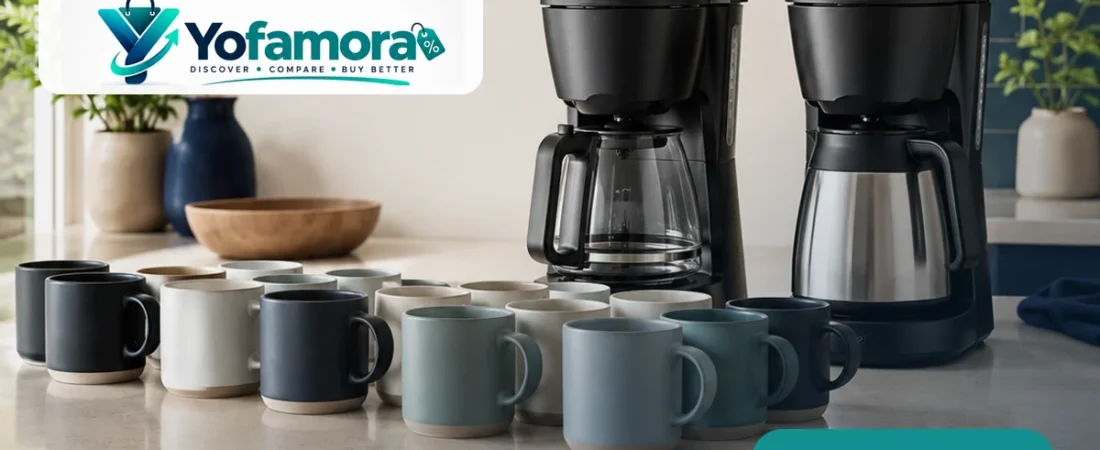
Updated August 2026. The carafe is one of the most overlooked parts of a drip coffee maker. Glass and thermal carafes can both make sense, but they keep coffee hot in very different ways.
Affiliate disclosure: As an Amazon Associate I earn from qualifying purchases.
Some links below are affiliate links. If you buy through them, Yofamora may earn a commission at no additional cost to you.
Quick answer
Choose glass if you like seeing how much coffee is left, usually finish the pot fairly quickly, and prefer the familiar warming-plate setup used by many mainstream brewers.
Choose thermal if you want the pot to retain heat without continuously sitting on a hot plate, especially when coffee may stay in the carafe for a longer period.
How a glass carafe works
A glass carafe is typically paired with a heated plate beneath it. The plate keeps the coffee warm after brewing.
Glass-carafe advantages
- You can immediately see how much coffee remains.
- Often found on more affordable machines.
- Simple to rinse and visually inspect.
- Warming-plate temperature may be adjustable on some models.
Glass-carafe trade-offs
- The warming plate continues applying heat.
- Coffee kept hot for a long time can change in flavour.
- Glass can break if dropped or hit.
Cuisinart’s PerfecTemp DCC-3200C uses a 14-cup glass carafe and includes adjustable warming-plate temperature.
How a thermal carafe works
A thermal carafe relies on insulation rather than continuous external heat. Once brewed, the coffee is held inside an insulated vessel.
Thermal-carafe advantages
- Keeps coffee warm without a warming plate.
- Useful when coffee sits for longer periods.
- Can be moved away from the machine while retaining heat.
- Often associated with premium drip brewers.
Thermal-carafe trade-offs
- You cannot see the coffee level through the carafe.
- Insulated carafes can be heavier.
- Some designs are more awkward to clean thoroughly.
- Premium machines can cost considerably more.
The Breville Precision Brewer Thermal is an example of a premium thermal-carafe machine designed around greater control over the brewing process.
Which keeps coffee tasting better?
If the pot will be consumed quickly, either design can work well. The difference becomes more meaningful when coffee sits.
Which should you buy?
| Priority | Better starting point |
|---|---|
| See how much coffee remains | Glass |
| Keep coffee hot without a plate | Thermal |
| Lower-cost mainstream options | Glass often has more choices |
| Take a long time finishing the pot | Thermal |
| Simple visual monitoring | Glass |
Bottom line
If you drink the pot soon after brewing, a good glass-carafe machine is simple and practical. If coffee often sits for an hour or more, thermal becomes much more compelling.
For specific models, see Best Coffee Makers in Canada (2026). If capacity is your bigger question, read 12-Cup vs 14-Cup Coffee Makers.
Research note: This guide compares design trade-offs using manufacturer documentation and product-positioning analysis. It is not presented as a hands-on durability test.