
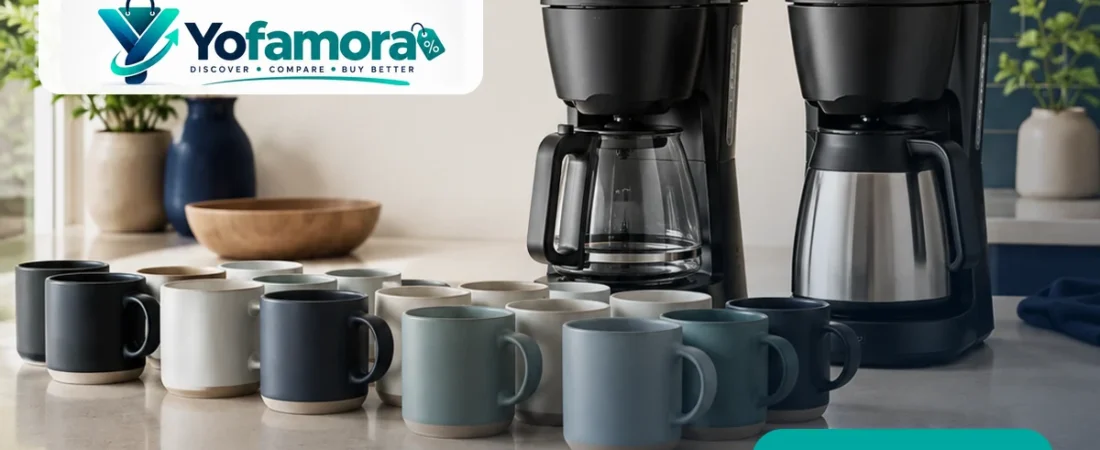
Updated August 2026. A 12-cup and a 14-cup coffee maker can look almost identical on a product page, but the better choice depends on how many people drink coffee, how often you refill, and whether you regularly brew for guests.
Affiliate disclosure: As an Amazon Associate I earn from qualifying purchases.
Some links below are affiliate links. If you buy through them, Yofamora may earn a commission at no additional cost to you.
Quick answer
Choose a 12-cup coffee maker if you want a familiar full-size machine for one or two regular coffee drinkers, smaller households, or buyers who do not often empty an entire large pot.
Choose a 14-cup coffee maker if you routinely brew for several people, refill mugs throughout the morning, entertain guests, or simply want more headroom before starting a second pot.
12 cups vs 14 cups is a smaller difference than it sounds
Coffee-maker “cups” are not the same as a typical 250 mL kitchen cup. Manufacturers often use a smaller serving definition. BLACK+DECKER, for example, specifies that its 12-cup model uses an approximately 5 oz cup measure. Compare the manufacturer’s stated capacity and your normal mug size rather than assuming “12 cups” means twelve large mugs.
Who should choose a 12-cup machine?
A 12-cup brewer is the practical default for many homes. It has enough capacity for multiple servings without taking the “bigger is always better” approach. The BLACK+DECKER CM1110BC is a useful example: it combines a 12-cup glass carafe with programmable auto-brew, brew-strength selection and Sneak-A-Cup functionality.
Advantages of 12-cup models
- Enough capacity for most households.
- Often a better fit for smaller counters.
- Less temptation to brew far more coffee than you will drink.
- Widely available in value-focused and mainstream models.
Check BLACK+DECKER on Amazon.ca
Who should choose a 14-cup machine?
Fourteen-cup brewers make sense when capacity matters more than compactness. Cuisinart’s PerfecTemp DCC-3200C is a 14-cup programmable glass-carafe brewer with regular/bold strength control, a 1–4 cup mode, programmable start and adjustable auto-off. The larger carafe gives frequent coffee drinkers more room while still offering a small-batch mode for days when you do not need a full pot.
Advantages of 14-cup models
- Better for multiple coffee drinkers or frequent refills.
- Useful when entertaining.
- Can reduce the need to brew a second pot.
- Some models still offer a small-batch mode for flexibility.
What matters more than the extra two cups?
Capacity matters, but it should not be the only reason you choose one machine over another. In everyday use, programmability, carafe type, warming behavior, small-batch performance, ease of cleaning and counter space can matter more than the difference between 12 and 14 cups.
Programmability
If you prepare your coffee the night before, a scheduled start can have more impact on your morning routine than the extra capacity.
Small-batch performance
If you often brew only a few cups, look for a dedicated small-batch setting.
Glass vs thermal carafe
Many 12- and 14-cup machines use a glass carafe with a warming plate, while premium machines may use a thermal carafe. If you keep coffee for a long time after brewing, carafe type can matter more than nominal cup count.
Next: Glass vs Thermal Carafe Coffee Makers
Our recommendation by household type
| Household / use | Better starting point |
|---|---|
| One regular coffee drinker | 12-cup, or smaller if you rarely brew a full pot |
| Two regular coffee drinkers | 12-cup usually works well |
| Family / multiple coffee drinkers | 14-cup can be more convenient |
| Frequent guests / entertaining | 14-cup |
| Small counter / occasional brewing | Prioritize dimensions and small-batch performance over maximum capacity |
Bottom line
There is no universal winner. A 12-cup machine is the sensible mainstream choice for many homes, while 14 cups is useful when you genuinely consume the extra capacity.
For product recommendations, see our Best Coffee Makers in Canada (2026) guide.
Research note: This guide is based on manufacturer specifications and buyer-use analysis. Yofamora did not conduct hands-on laboratory testing of every product mentioned.